Lies, censorship, and nonsense from all warring parties can’t obscure the harsh realities for Iranians inside Iran: More from my exclusive source inside Iran
(Traduce en español/translate to Spanish / Farsi/Persian فارسی / Kurdish (Kurmanji) and کوردی (Sorani) / Arabic الترجمة العربية / Hebrew תרגום לעברית)
By Brian E. Frydenborg (Twitter @bfry1981, LinkedIn, Bluesky, Facebook, Substack with exclusive informal content) April 2, 2026; because of YOU, Real Context News surpassed one million content views on January 1, 2023, but I still need your help, please keep sharing my work and consider also donating as I make my overdue comeback! Real Context News produces commissioned content for clients upon request at its discretion. And see my related thread on the Iran-Israel-U.S.-war with over 1.3 million views. I have made only light edits to punctuation/grammar and spelling with direct quotes at most. And apologies for not getting this out earlier, things have been overwhelming for me but I am still moving forward. The actual words of my source are in bold or block quotes below, though all hyperlinks have been added by myself.
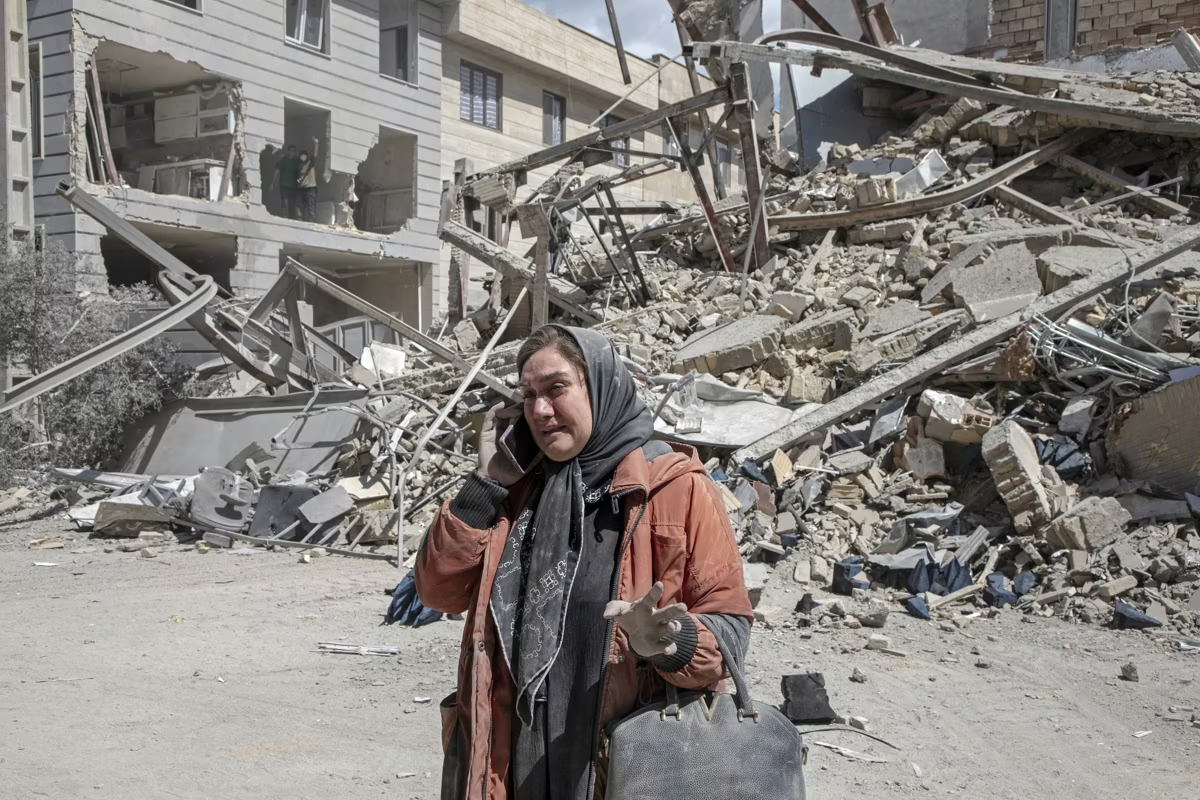
(Photo by Majid Saeedi/Getty Images)
SILVER SPRING and THROUGHOUT IRAN—Our young Iranian heroine with a journalistic background from our last update from within Iran expresses truly deep and heartfelt appreciation, repeatedly, that we are ensuring her voice and people are heard. Shas been on the road visiting family and friends in various provinces of Iran (to “breathe for a while since attacks are much lighter” than in Tehran), each leg so far progressively safer than the capital of Tehran, the war following somewhat with delayed effect at times (again, to make it harder to track her for her safety, other than Tehran, we will leave the specific locations a mystery for now).
Two weeks ago, she noted to me that she had left Tehran and, that attacks had spread to and further included infrastructure: “Everything is getting more complicated, with people fearing a real war on the horizon and probable severe cuts in food, gas, and transportation.”
A few day later, at her more remote location (“Much safer. And much more conservative”) than Tehran, for her it “is shocking when it comes to the governmental propaganda. Government supporters gather every night in streets, some having AK-47, shouting and singing.” And even though her new location was bombed less than Tehran, “still attacks are large…and you can see it even when you are walking in the streets.” It was still shocking for her, a “touristy city of Iran, witnessing empty landmarks and streets for a first time in a long time.” This is like nothing she—nor, presumably, most readers—had ever experienced, so you can sense the surreal quality of everything for her in her words.
She is fortunate; most people have no internet access and little idea what is happening, leading some “inside” Iran to think that the “U.S. [was] defeated in some ways, while making people outside…[become] distanced from what people think inside.”
As days go on, she notes in her area that mostly military targets are being hit by a barrage of missiles but also gas infrastructure, on the move to yet another location.
At her new “village,” it is “much safer” and relatively calm: “from here I can only hear fighter aircrafts passing.”
Wherever they get their information or if just from rumor, “people are smelling an agreement 🙂 and many of them don’t like it, whether they are in the government defender team or not.” [Brian here: on a personal note, I have to say that the phrasing “government defender team” is brilliant, at least in English!!”] She continues: “People are not for an agreement. Though, we see a limited ground invasion coming. As I told you before, I believe they are coming for [some] land; clearer now, for Kharg and the other islands in the south. So yes, unfortunately, the troops are coming.“
During this time, Israeli and U.S. attacks were increasingly going beyond more traditional military targets, and this was not lost on the locals:
“Now it’s getting more complicated. Attacks like ones again Ahwaz and Isfahan infrastructure, don’t make it easier for people to keep their faith in the war and the possible regime change afterward. We gradually [increasingly] believe that the Iranian people are not part of this equation, so we simply try to survive.”
Then, in another email to more heart-wrenchingly drive the main point through: “To put it more precisely, what we think as Iranian people doesn’t matter here.” That is the lesson the conduct of the war by the U.S. and Israel is teaching the people in Iran.
At the same time, in response to a question, she makes it clear that, while the U.S. had most of the people supporting it early on and has since lost some support, “that doesn’t mean that people are turning to the government. They are losing faith in the outcome of war.”
She described three dynamics happening simultaneously among the people:
“First, the attacks are now against industrial infrastructure, comparing to the beginning that was only against military targets.
Second, the internet lock down and just receiving information from the government, its agencies, and its broadcast, has made people to believe Islamic Republic is progressing on some fronts and is successful in pressuring the neighboring countries.
Third, it’s not a joke; war is war and it’s frustrating. The longer people are in this situation, more they lose perspective, let alone the faith.
Fourth, territorial integrity is a strict line for Iranian people, especially in the south, where the tension has been always high. So if the U.S. put a finger there, the people positioning would change drastically against it. But as I’ve already said, Iranian people are not part of this equation, and them being happy or angry is not something both sides—either the U.S. or The Islamic Republic—consider.”
In response to a question as to if the war if causing division among the people, among families, she notes that such divisions do not begin or end with the war:
“I’m so sad to say this, but people are fractured deeply, not solely because of the war. The January massacre and things that happened after that was the starting point, and the war has deepened that; since one side feels ignored, shattered, and hurt during the protests or even before that—during last 47 years—and now think of this war as a revenge they couldn’t get themselves. On the other side is the group believing that whether the government did the mass killing or not, people have to stand with the government against foreign powers.”
The sad truth is that most Iranians are simply caught up in these waves of history:
“People can’t do much. They are planning to start their new year cautiously, with buying things they may need in long term, making safe places in their house, or try to stay safe and sound. However, it’s about the people in general; those who supports the government, still gather every night in streets chanting and shouting, while the IRGC has invited their children, from 12-year-olds and above, to join the street forces and learn how to use weapons. So it seems like two battles when you take a look at Iranians these days; one of those being ignored the whole 47 years, and those who prefer to stand with the government for whatever reason they might have.”
But she noted that “there is something else that you should look at while assessing the situation,” as the “I.R. [Islamic Republic of Iran] is not simply a dictatorship with malfunction that a war—especially one like this—can overthrow”:
For decades, by making parallel structures, it has separated its life line from people and so-called government.
The organization is super complicated that is fed with crisis. Execution of Imam Khomeini’s Order (EIKO) acts as the organization’s brain, controlling every vital part of economy including, oil, medicine, and, IT infrastructure. The Mostazafan Foundation of Islamic Revolution acts as its arm, executing the most important big projects in road, border, and industrial construction. These two beside some other arms of the I.R. have everything in hand, working globally through their paper companies and holdings in Dubai, London, and Istanbul. So, no war can take I.R. down without targeting these bodies, because the backup of every scenario is in their hand and, of course, money, too.”
She pointed to an Iranian analyst based in Toronto, Canada, named Bahram Rameh, and recommended his analysis.
We also both noted neither of us were surprised about the entry of the Houthis: “Yes, we were waiting for them to jump in 🙂 ” [take the smiley more as an eye-roll than any sort of approval], she wrote, and that she “can’t agree more” on that inevitability and their timing being quite strategic. Despite all of this and the disappointment in the U.S., this still has not, in her view, translated to an increase in support for the I.R. regime:
“Hating or fearing war doesn’t mean supporting the government. The change is that more people were optimistic about the war at the beginning, and now its shrinking. So no, they aren’t supporting I.R. more, but they are fearing an irreversible outcome of war approaching.”
She also had some profound insight on how all this fits together:
“Something I wanted to say about civilians: it’s naive if we see the rise in civilian death toll solely as a result of the war, meaning missiles and attacks. This outcome equally comes from I. R. completely ignoring the civilian population. It doesn’t care to provide attack alarms, shelters, or places for evacuation. Many people would consider leaving Tehran or big cities if they had somewhere to go. The government is equally responsible for this rise in death. Moreover, people feel helpless; after attacks they have to one to turn to; they don’t know where they should start to take their home back or how they can rebuild that. The only groups that are on the ground are rescuers and fire fighters.”
As she correctly noted in our previous exchanges, their own government in January killed more Iranians that U.S. or Israeli weapons have during this subsequent war.
Truly, the Iranian people are some of the biggest victims in this war, and are stuck with no good options as hostilities increase between parties that clearly care little to nothing for their welfare or future, from Tehran to Tel Aviv to Washington.
See my related thread on the Iran-Israel-U.S.-war with over 1.3 million views and my earlier piece with my contact.
© 2026 Brian E. Frydenborg all rights reserved, permission required for republication, attributed quotations welcome
Also see Brian’s eBook, A Song of Gas and Politics: How Ukraine Is at the Center of Trump-Russia, or, Ukrainegate: A “New” Phase in the Trump-Russia Saga Made from Recycled Materials, available for Amazon Kindle and Barnes & Noble Nook (preview here).

If you appreciate Brian’s unique content, you can support him and his work by donating here; because of YOU, Real Context News surpassed one million content views on January 1, 2023. Real Context News produces commissioned content for clients upon request at its discretion.
Feel free to share and repost this article on LinkedIn, Facebook, Threads, and Twitter. If you think your site or another would be a good place for this or would like to have Brian generate content for you, your site, or your organization, please do not hesitate to reach out to him!